
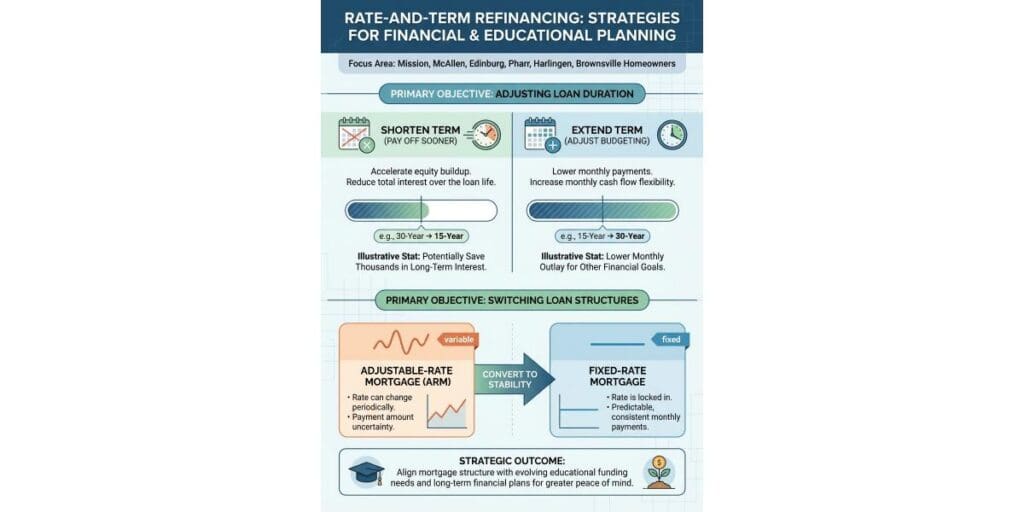
A rate-and-term refinance in the Rio Grande Valley replaces your current mortgage with a new one, allowing you to change the rate, the term, or both. The new balance stays close to what you owe. You are not pulling equity out as cash. Homeowners in Mission, McAllen, Edinburg, Pharr, Harlingen, and Brownsville use it when the loan they closed no longer matches the household: an adjustable rate they want to leave, a term they want shorter, or a remaining schedule they want to reset.
This is not a cash-out refinance. It is not an FHA streamline, which is only for an existing FHA loan and uses a shorter document list. It is not a VA IRRRL, which is only for an existing VA loan. Rene Rodriguez, NMLS 174065, at LeaderOne Financial Corporation, NMLS 12007, sorts those four names before anyone talks numbers. This page does not quote a rate.
How a Rate-and-Term Refinance in the Rio Grande Valley Works
The lender pays off the old loan at closing. You sign a new note. The old servicer sends a payoff. Escrow for taxes and insurance is rebuilt on the new loan, which is why the cash due at closing and the first new payment can look different from a simple “same balance” story.
Limited closing costs can be rolled into the new loan. There is a cap, and it is the lender’s cap, not a round number from a blog. Rolling costs in means the balance ticks up. That tick is not cash-out. Cash-out is when you deliberately increase the loan to take proceeds. If you need proceeds, say so. Pretending a cash-out is a rate-and-term creates a Texas homestead problem and a worse underwrite.
In Texas, a refinance of your homestead follows state rules that are stricter than in many other states once any cash comes out. A true rate-and-term, with no cash to you, is a different path from a Texas cash-out. Ask which path the new loan is before you sign. The label on the advertisement is not the label on the closing disclosure.
How it differs from the streamline programs
- Rate-and-term. A full refinance. Credit, income, and usually an appraisal. Works when you are changing programs or when no streamline fits. The balance stays near the payoff.
- FHA streamline. You already have an FHA loan. The document list is shorter. It is still not a cash-out. It will not refinance a conventional loan.
- VA IRRRL. You already have a VA loan. Seasoning and a net tangible benefit test apply. It will not refinance an FHA or conventional loan.
- Cash-out. The balance goes up on purpose and you receive proceeds. Expect a fuller review, a different loan-to-value cap, and, on a Texas homestead, a different legal path. It also has its own waiting period after a purchase. Confirm that period. Do not assume you can cash out the month after closing.
Switching from an FHA loan to a conventional rate-and-term is a common reason the streamline is the wrong tool. Owners do it when they want to drop monthly mortgage insurance and they have the equity and the credit for a conventional loan. Whether the insurance actually drops depends on the new loan-to-value. Get the payoff and a value opinion before you treat the drop as certain.
What the lender will read
Plan on a full application, not a postcard.
- Photo ID and the names on the current note. Adding or removing a borrower is allowed only if the new application supports it. After a divorce, bring the decree. Do not leave a person off the application and hope the title company sorts it out in Harlingen on closing day.
- Income. Pay stubs and W-2s for a wage earner. Tax returns and a year-to-date profit picture if you are self-employed in the Valley. Seasonal income needs the full year, not the busy months only.
- Assets, if you will bring cash to closing for costs you are not rolling in.
- The mortgage statement, homeowners insurance, flood policy if the map requires it, and the tax bill.
- HOA contact information if the home is a condo or a townhome. Condo project review can outlast the rate conversation.
An appraisal is typical. A value that comes in low can shrink what can be rolled in, or it can end the idea of dropping mortgage insurance. Order the appraisal inside a window where you can still walk away.
Credit is pulled. Do not open a new car loan or a furniture account while the refinance is in underwriting. New debt changes the payment the underwriter just approved.
Reasons that hold up, and reasons that do not
Hold up: leaving an ARM before it adjusts, shortening the term because the payment still fits, moving from FHA to conventional once the equity is there, or replacing a loan whose features you have outgrown. Each of those can be checked against your statement.
Do not hold up: refinancing only because a postcard said the market moved, without reading the costs and the recoup. A small payment change that takes many years to earn back the costs is a weak refinance. This page will not invent the payment or the cost. Put your payoff, your insurance, and your tax escrow on one sheet and ask for the new payment in writing.
Also weak: refinancing a house you plan to sell in a few months in McAllen or Brownsville. The closing costs are real. A short stay in the house may never earn them back. If a sale is likely, ask what it costs to keep the current loan until the sale.
A clean order of steps
- Write down the current balance, rate type, remaining term, and whether mortgage insurance is on the statement.
- Decide the job: change the rate, change the term, leave an ARM, or drop insurance. One primary job.
- Confirm you are not trying to take cash. If you are, stop and underwrite it as a cash-out.
- Confirm it is not an FHA streamline or a VA IRRRL. If it is, use that product’s rules instead of this page.
- Send the statement to Rene Rodriguez at LeaderOne Financial Corporation and ask which documents the chosen path still needs.
- Read the closing disclosure. The cash to you should be none, or only an escrow refund that was explained. A surprise check is a cash-out.
Questions owners ask
Can I roll closing costs into the loan?
Often, up to the lender’s cap, if the value supports it. Rolling costs in is not the same as taking cash out. Ask for the cap on your numbers.
Will my payment go down?
Not always. A shorter term can raise the payment and still be the right refinance. A longer term can lower the payment and cost more interest over time. Compare both.
Do I need an appraisal?
Usually yes on a rate-and-term. Streamline programs are the ones that sometimes skip it, and only when you already have that loan type.
What if I have a VA loan?
Start with the IRRRL rules if you are not taking cash. A rate-and-term into a non-VA loan gives up the VA structure. Know that before you switch.
Where do I start?
Bring your mortgage statement to renerodriguezleaderonefinancial.com to explore a rate-and-term refinance in the Rio Grande Valley today. Rene Rodriguez will tell you whether a rate-and-term, an FHA streamline, a VA IRRRL, or a cash-out is the loan you actually need.
Rene Rodriguez, NMLS 174065, is a mortgage loan originator with LeaderOne Financial Corporation, NMLS 12007, in the Rio Grande Valley. Equal Housing Lender. This article is educational. It is not an approval and it does not quote a rate. The next step is renerodriguezleaderonefinancial.com.
